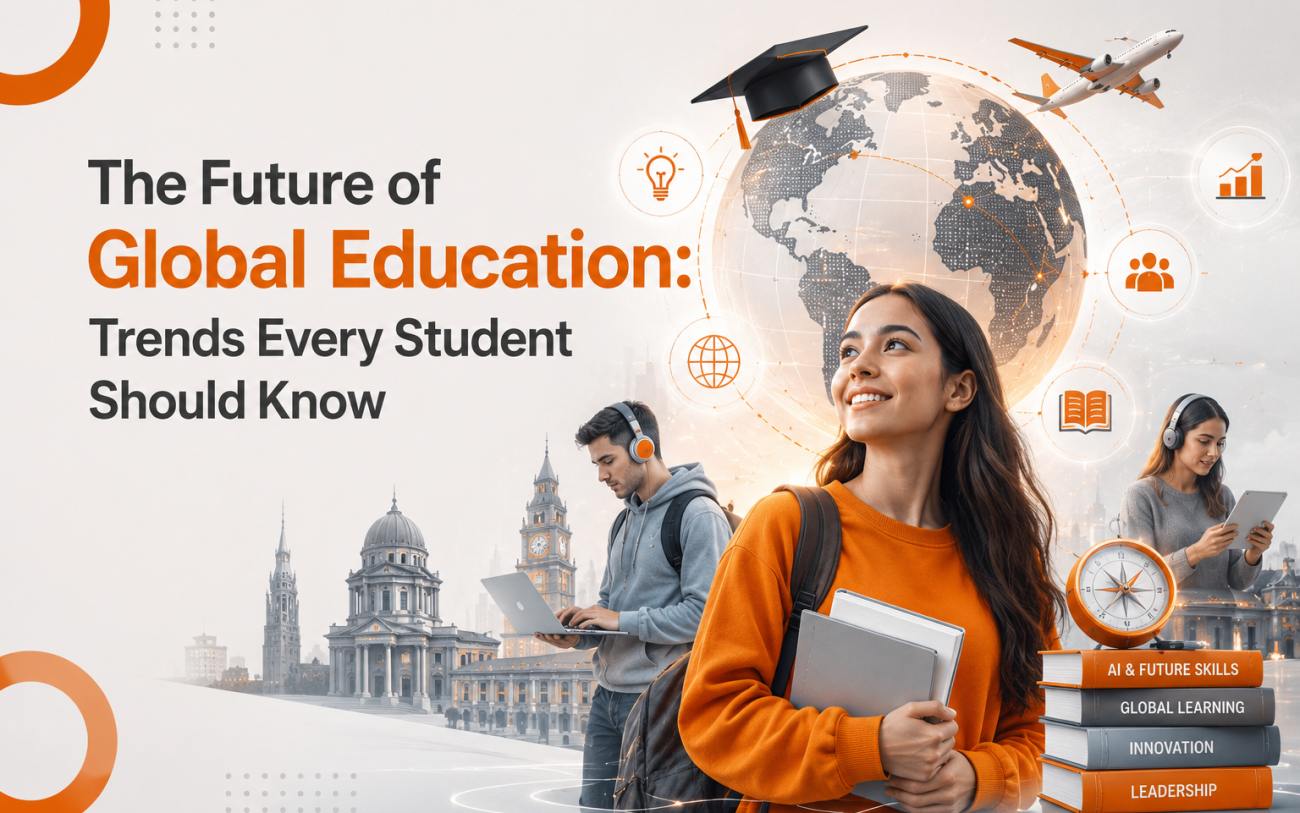
The Future of Global Education: Trends Every Student Should Know
How Technology, Global Mobility, Artificial Intelligence, and Changing Career Demands Are Reshaping Education Worldwide
“The future of education will not be defined by the universities students attend, but by their ability to learn, adapt, and thrive in a rapidly changing world.”
Introduction: The New Age of Education
Traditionally, the route to success seemed clear: attend a good school, get a university degree, find a job, and start building a career. This approach worked well in past eras, but in the twenty-first century, things are completely different.
Modern technology allows AI to write essays, conduct analysis, and perform mundane jobs. Companies hire people regardless of their nationality. Employees’ skills become more valuable than degrees. Entire new industries appear at an unprecedented pace.
Consequently, the very role of education changes.
Today’s university students train for careers that have yet to appear, technologies that are not invented yet, and problems which are yet to be discovered. This marks one of the most fundamental transitions in the world of education.
To stay up-to-date, competitive, and globally oriented, it becomes necessary for today’s students to understand the future of education.
Why the Evolution of Education is Rapidly Occurring on a Global Scale
A number of factors are concurrently changing education on a global scale.
They include the following:
- Artificial Intelligence
- Digital transformation
- Mobility of global workforce
- Industry-led learning
- Competency-based recruitment
- Need for lifelong learning
Unlike past educational innovations, all of these developments are happening concurrently.
Factors Reshaping Education
Driver of Change | Impact on Education |
Artificial Intelligence | Personalized and adaptive learning |
Globalization | Cross-border educational opportunities |
Technology | Hybrid and online learning models |
Industry Needs | Skills-focused curriculum development |
Demographic Shifts | Increased international student mobility |
These developments are collectively redefining how students learn, what they learn, and why they learn.
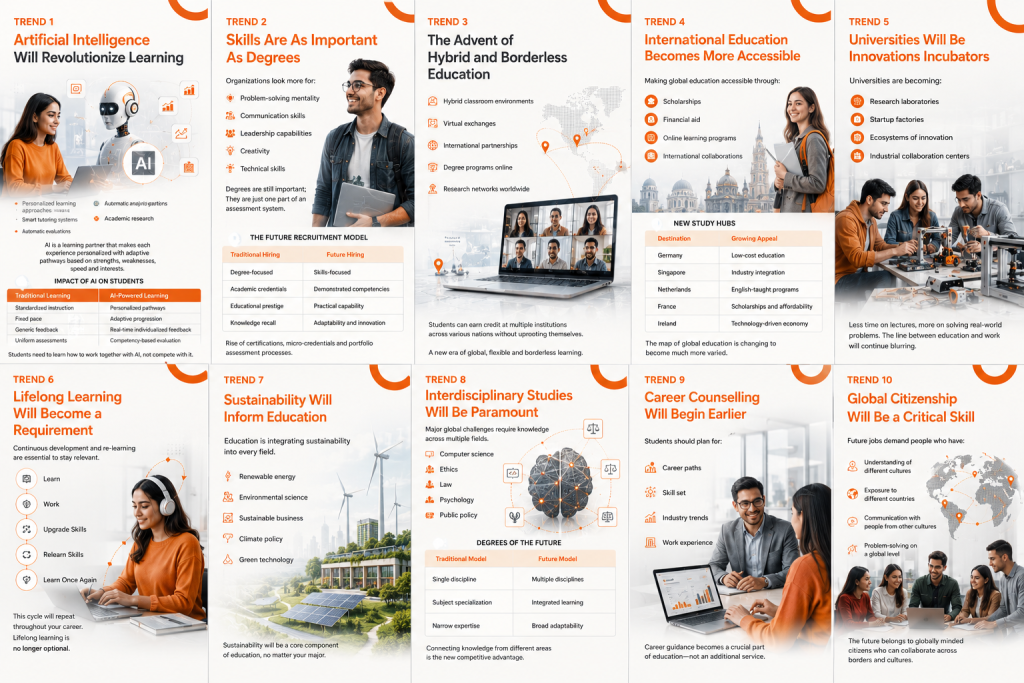
Trend 1: Artificial Intelligence Will Revolutionize Learning
Any talk about the future of international education would be incomplete without discussing Artificial Intelligence.
AI is currently impacting:
- Personalized learning approaches
- Smart tutoring systems
- Automatic evaluations
- Learning analytics
- Academic research
While not meant to replace teachers, AI will soon emerge as a learning partner capable of making each learning experience personalized.
A classroom where students take different learning pathways, based on their strengths, weaknesses, learning speed, and interests, may no longer remain a distant dream but an emerging reality.
Impact of AI on Students
Traditional Learning
AI-Powered Learning
Standardized instruction
Personalized pathways
Fixed pace
Adaptive progression
Generic feedback
Real-time individualized feedback
Uniform assessments
Competency-based evaluation
Rather than competing with AI, students need to learn how to work together with AI.
Trend 2: Skills Are As Important As Degrees
Degrees were the key marker of competence for many years.
Today, however, organizations look more for indications of:
- A problem-solving mentality
- Communication skills
- Leadership capabilities
- Creativity
- Technical skills
Degrees are still important; they are just one part of an assessment system.
The Future Recruitment Model
Traditional Hiring | Future Hiring |
Degree-focused | Skills-focused |
Academic credentials | Demonstrated competencies |
Educational prestige | Practical capability |
Knowledge recall | Adaptability and innovation |
This is causing a rise in the number of certifications, micro-credentials, and portfolio assessment processes.
Trend 3: The Advent of Hybrid and Borderless Education
The pandemic has hastened an ongoing process, where learning does not necessarily require a fixed physical space.
Institutions are increasingly offering:
- Hybrid classroom environments
- Virtual exchanges
- International partnerships
- Degree programs online
- Research networks worldwide
Students will soon have the opportunity to earn credit at multiple institutions across various nations without uprooting themselves.
This represents a change to conventional ideas about study abroad experiences.
Trend 4: International Education Becomes More Accessible
Traditionally, international education has been seen more as a luxury open only to wealthy individuals.
Nevertheless, countries and institutions have made efforts recently to make it accessible by providing:
- Scholarships
- Financial aid
- Online learning programs
- International collaborations
Examples of such countries include Germany, France, Singapore, and many others in the Nordic region.
New Study Hubs
Destination | Growing Appeal |
Germany | Low-cost education |
Singapore | Industry integration |
Netherlands | English-taught programs |
France | Scholarships and affordability |
Ireland | Technology-driven economy |
The map of global education is changing to become much more varied.
Trend 5: Universities Will Be Innovations Incubators
The future university will be more than just giving lectures and conferring diplomas.
On the contrary, universities are progressively turning into:
- Research laboratories
- Startup factories
- Ecosystems of innovation
- Industrial collaborations centers
Less time will be spent on being lectured to and more time on finding solutions to problems.
The line between education and work will continue blurring
Trend 6: Lifelong Learning Will Become a Requirement
One of the most significant changes will undoubtedly be the realization that education never stops after graduation.
Continuous development and re-learning in response to constantly evolving technology are required in order to remain competent.
Future Learning Process
- Learn
- Work
- Upgrade Skills
- Relearn Skills
- Learn Once Again
It can happen several times during one’s professional career.
Consequently, lifelong learning is inevitable.
Trend 7: Sustainability Will Inform Education
The impact of climate change, environmental issues, and sustainable development is becoming a greater influence on educational institutions around the world.
Educational institutions are offering more courses that include:
- Renewable energy
- Environmental science
- Sustainable business
- Climate policy
- Green technology
For students starting university studies today, sustainability can be expected to be an important part of education regardless of their major field of study.
Trend 8: Interdisciplinary Studies Will Be Paramount
Increasingly, many of the major problems faced by the world do not fall within any one traditional academic discipline.
AI technology, for example, necessitates knowledge in such diverse fields as:
- Computer science
- Ethics
- Law
- Psychology
- Public policy
- Degrees of the Future
Traditional Model | Future Model |
Single discipline | Multiple disciplines |
Subject specialization | Integrated learning |
Narrow expertise | Broad adaptability |
Those students who possess the ability to connect their knowledge from different areas will have a great advantage.
Trend 9: Career Counselling Will Begin Earlier
The connection between education and job readiness becomes closer and closer.
Students should be able to develop a strategy for:
- Their career paths
- Their skill set
- Industry trends
- Work experience
That’s why career guidance becomes a crucial aspect of education planning instead of being an additional service.
Trend 10: Global Citizenship Will Be a Critical Skill
The workforce of the future will be working in an international environment.
It means that employees appreciate those who show:
- An understanding of different cultures
- Exposure to different countries
- Communication with people from other cultures
- Problem-solving on a global level
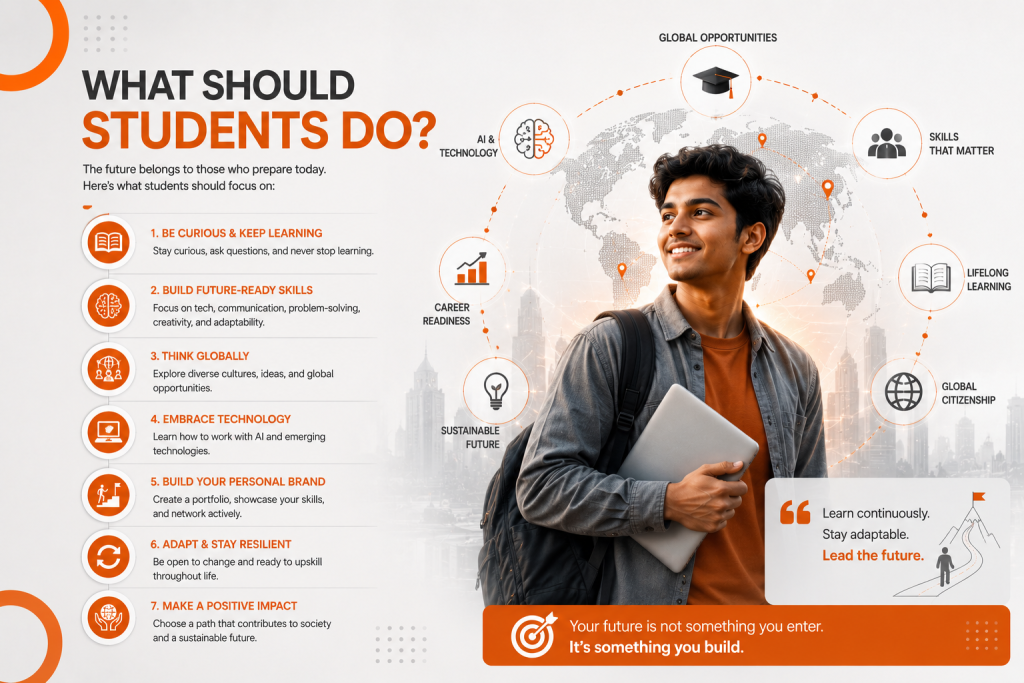
What Should Students Do?
Although the aforementioned factors appear daunting, they also provide huge opportunities.
Students must concentrate on the following:
- Future-Ready Skills
- Adaptability
- Critical thinking
- Communication
- Digital literacy
- Leadership
- Collaboration
These are the skills that would remain valuable despite any technological advancement.
Future Profile of the Ideal Student
The most successful students of the coming decade would be those who combine:
Academic Strength | Future Skill |
Subject expertise | Adaptability |
Technical knowledge | Creativity |
Analytical ability | Communication |
Academic excellence | Problem-solving |
This will determine what constitutes educational success in the years to come.
FREQUENTLY ASKED QUESIONS
How does AI transform education?
Do degrees really matter in the future?
What are the latest study abroad trends for 2030?
What are the essential skills in the future?
Conclusion: Education is Becoming a Journey, Not a Destination
The future of education worldwide is not just about innovative technology and changes to the structure of universities. In its essence, it stands for a complete transformation of the understanding of learning.
Education is evolving from a process based entirely on acquiring information to one based on adaptability, lifelong growth, and global connections. Future learners will not only need to be informed but also adaptable, collaborative, and capable of solving issues beyond the bounds of a specific discipline.
In such a new world, the winners will not be the ones who know the most things, but rather people who always stay open-minded and eager to learn.
There will definitely be upheavals in the future, but at the same time, there will be fantastic possibilities for the ready to change
“Perhaps the most important skill of the future won’t be about knowing things now; it will be about your ability to learn new things fast enough to meet tomorrow’s requirements.”
Call for Action
At Ethos Education, we assist students to get prepared for both university admissions as well as their future life through:
- Career and academic counseling
- Guidance for studying abroad
- Profile creation and mentoring
- Admissions and scholarship assistance
- Future-proofing educational planning
The future of education is happening now. Begin your preparation now and be ready for the opportunities of tomorrow.